One of the association's purposes is raising awareness of CMD (craniomandibular dysfunction). That is why we provide training and continuing education for healthcare professionals: structured, practical and interdisciplinary. Knowledge that gets through.
Our remit
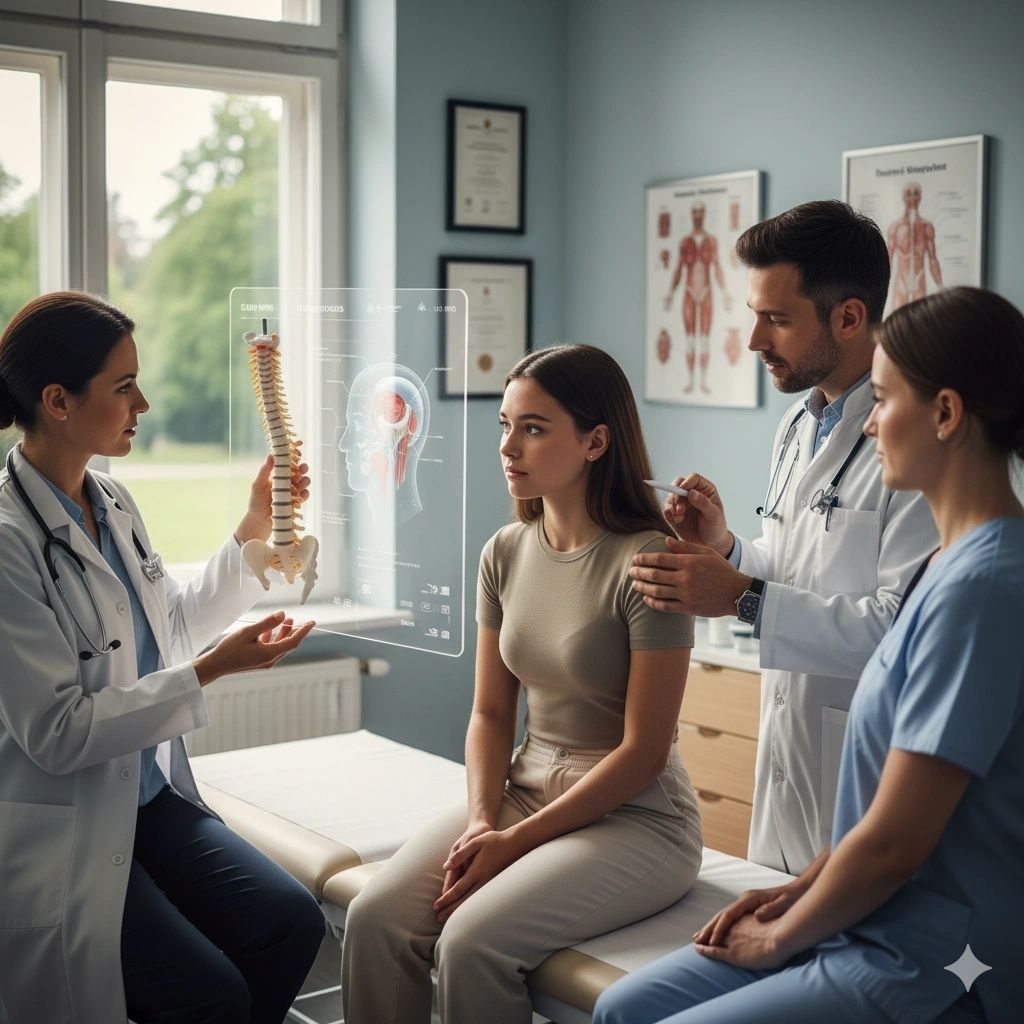
CMD is an interdisciplinary interface. Our CME courses bring together doctors, dentists and therapists, so that the connection around the jaw system is recognised earlier in everyday practice.
CMD lies in the blind spot between specialties. The more healthcare professionals recognise the connection, the sooner people affected are heard.
Our training programme translates CMD regulatory medicine, together with the CMD regulatory therapy and CMD systems therapy derived from it, into knowledge that can be taught and examined: evidence-oriented, with an honest distinction between evidence, consensus and hypothesis, and without disparaging other methods.
🦷 Dentists: functional diagnostics, interface with medicine
🩺 Doctors (general practice, ENT, neurology, orthopaedics): referral & interplay
💪 Therapists (physiotherapy, osteopathy, speech therapy): supportive regulation
The path
Not a curriculum you have to complete before it becomes useful. One afternoon with one clear goal: being able to decide whether you have a CMD patient in front of you. Each session is self-contained.
What the jaw system is and what CMD means. The three symptom clusters and why head, ear and neck belong together. Starts from zero prior knowledge.
45 minutes
Three questions, four manual tests, measuring mouth opening. Can be carried out in under five minutes, without risk and without equipment. Practised live, in pairs on your neighbour.
50 minutes, the core of the afternoon
Red flags and differential diagnoses, with giant cell arteritis as the most important mimic. Then: when and where to refer.
35 minutes
Follow-on formats are in preparation. We are developing them further with those who have taken part — anyone who would like to contribute, in the study group, on the curriculum or as a speaker, can tell us at the end of the course.
We do not disparage other methods and promise no cure; we present connections as a possibility.
Formats
CMD is an interdisciplinary interface; our formats reflect the real network of practitioners.
One target group, focused (e.g. “CMD for GPs”). Ideal for getting started.
Two groups with a shared plenary and specialty-specific in-depth sessions (e.g. doctors + physiotherapy or dentists + physiotherapy).
The large format once a year: all practitioner groups in one room: plenary, parallel specialty tracks and joint case work.
How you learn
Digital teaching workbook for each specialty (orthodontics first) with exam-based module unlocking, at your own pace.
Become a member (in German) →Courses with practical components and renowned speakers.
CME course on CMD for doctors: dates & programme →Interdisciplinary case discussions and journal club, developing things further together.
Join (in German) →Dates
Whether a CME course for doctors, an open community meeting or a public talk, our events create space for learning together and for interdisciplinary exchange on CMD and scoliosis.
Next date
A CME day for general practitioners, ENT specialists and orthopaedic specialists: How do I recognise CMD, when should I think of it, and how do I refer appropriately? The course runs monthly and is self-contained. The course is held in German.
Thu, 22.10.2026 · 14:00–17:00 · then monthly, every third Thursday
Venue: premises of the CMD-Klinik Wollerau (as host and venue).
Alternative venue: Restaurant Erlenmoos if there are more than ten participants; the final venue will be
communicated with the registration confirmation.
Fees for doctors: CHF 590 until 21.09.2026, then CHF 690 until 12.10.2026, from 13.10.2026
CHF 790. Members pay 30 per cent less.
Recognition: SGOT 3 credits for the three-hour event; creditable in all
other specialties as extended continuing education.
Monthly, every third Thursday, except July and August. Always the same three-hour course, always for new participants. So there is never a wait for the next opportunity to join.
Follow-on formats are in preparation; we will announce dates as soon as they are fixed. Ask us about them →
We inform and connect; we do not treat, and we promise no cure. We present connections around the jaw system as a possibility, not as a proven cause.
Who teaches
General practitioner & chiropractor · Neckertalpraxis
Medical and structural part: epidemiology, ENT evidence, red flags & differential diagnoses.
Physiotherapist · focus on CMD · Physiomed Rottweil
Practical and functional part: screening practice and the musculoskeletal jaw–spine axis.
Would you like to share your knowledge? We are looking for experienced healthcare professionals.
Get in touch →The e-workbook, recordings, study group and certification are open to members. Become part of the network and help carry the topic further.